

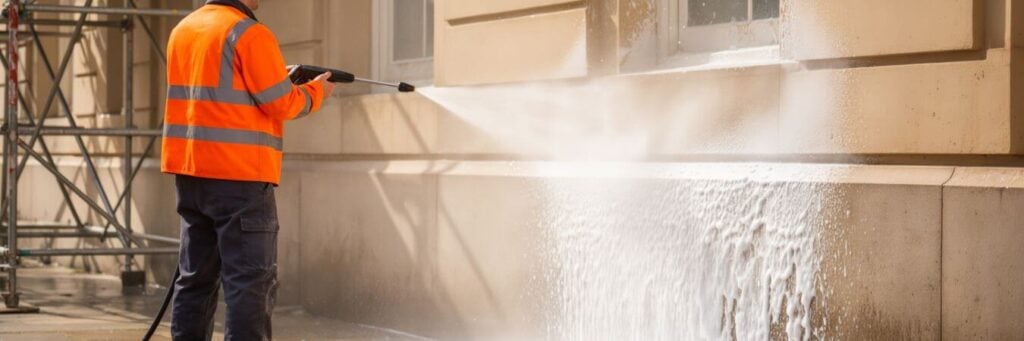
Blasting away a year’s worth of southern hemisphere winter grime, black mould, and stubborn lichen from your home is incredibly satisfying. However, achieving a great-looking, streak-free finish without wasting product or possibly damaging your paintwork comes down to simple fluid dynamics.
ChemShop House Wash Concentrate calls for a 1:40 end-use dilution ratio, so pouring it straight into your water blaster’s onboard detergent tank without calibrating for the machine’s internal mechanical siphon will yield incorrect, less-than perfect results. And you risk burning through your industrial-strength solution up to four times faster than necessary.
Here is exactly how to calculate your water blaster’s true chemical draw rate, mix your product accurately, and protect your home’s exterior cladding envelope.
The Mechanics of Chemical Injection: Flow Rate vs. Siphon Rate
Water blasters do not spray what is sitting inside their soap tank directly onto your walls. Instead, they leverage an internal downstream Venturi injector that pulls a metered amount of soap and blends it with a large volume of pressurised fresh water coming from your garden hose.
Because these machines mix soap exclusively at low pressure, you must utilise the machine’s maximum water flow rate to accurately determine the true application strength.
The Conversion Formula
To convert your pressure washer’s fluid dynamics into an actionable dilution ratio, apply the following engineering standard:
This equation yields a clear ratio formatted as 1 : X (one part detergent to X parts fresh water).
Step-by-Step Practical Example (Kärcher K4)
If you own a standard Kärcher K4 water blaster, its manufacturing specifications typically state:
- Max Water Flow Rate: 7.0 L/min (420 L/hr)
- Detergent Flow Rate: 0.3 L/min (18 L/hr)
1. Run the calculation:
7.0 / 0.3 = 23.33
2. Interpret the result:
Your machine’s mechanical dilution ratio is approximately 1:23. This means for every 1 part of liquid pulled from the detergent tank, the machine automatically mixes it with 23 parts of water before it exits the nozzle face.
The Mathematical Formula for House Wash Water Blaster Dilution
Once you have executed the 1-minute bucket test or consulted your manufacturer’s specifications to find your machine’s mechanical draw rate, you must perform the final reconciliation calculation. This ensures the chemical solution hitting your building envelope lands precisely at the target 1:40 dilution ratio (2.44% active solution) required for premium products like ChemShop House Wash.
The Final Equation: Solving for Tank Mix
If your water blaster’s internal Venturi siphon draws chemical at a verified ratio of 1 : X (where 1 part tank fluid mixes with X parts hose water), and your target end-use dilution at the cladding is 1 : T (where T = 40), the exact volumetric ratio for your detergent reservoir is calculated as follows:
Where:
- X = The parts of hose water your machine mixes per 1 part of tank fluid (e.g., 23 for a Kärcher K4).
- T = The target final output parts (40 for standard maintenance washing).
- (T – X) = The remaining volume of water needed inside the tank to balance the mechanical siphon.
Practical Proof
Let’s apply this universal equation across common pressure washer configurations to establish exact chemical-to-water ratios inside your tank:
Example 1: The High-Flow Machine (Machine Ratio 1:22 – Kärcher K7 Series)
A standard Kärcher K7 features a maximum water flow rate of 10.0 L/min and a detergent flow rate of 0.45 L/min. Dividing water flow by soap flow (10.0 / 0.45) yields a mechanical draw rate of approximately 1:22.2 This means the machine naturally dilutes your tank fluid twenty-two times over. To hit a final 1:40 output concentration on your cladding:
Tank Mix = (22 + 1) : (40 – 22.2) = 23.2 : 17.8
Simplified for ease of measuring, this results in a 4:3 ratio. To prepare a perfect batch in your detergent reservoir, you will mix 4 parts ChemShop House Wash Concentrate to 3 parts clean water.
Example 2: The Slow-Drawing Machine (Machine Ratio 1:30 – Kärcher K2 Series)
A standard Kärcher K2 features a maximum water flow rate of 6.0 L/min and a detergent flow rate of 0.2 L/min. Dividing water flow by soap flow (6.0 / 0.2) yields a mechanical draw rate of exactly 1:30. This means the entry-level machine draws soap slowly, naturally cutting your tank fluid thirty times over. To hit a final 1:40 output concentration on your cladding:
Tank Mix = (30 + 1 : (40 – 30) = 31 : 10
Simplified for ease of measuring, this results in a 3:1 ratio. To prepare a perfect batch in your detergent reservoir or suction bottle, you will mix 3 parts ChemShop House Wash Concentrate to 1 part clean water.
Managing an irregular commercial setup or dealing with heavy organic infestations that demand a more aggressive 1:20 output? Avoid manual math errors by inputting your machine specs directly into the ChemShop Dilution Calculator for instant metric conversions.
The Reconciled Mix Matrix for Kärcher K-Series Models
Because domestic and commercial water blasters automatically scale both water throughput and chemical draw as you move up the product line, the concentration in your tank must adapt. If your machine draws soap slowly, your tank mix must be stronger; if it draws soap rapidly, your tank mix must be more diluted.
Use this general performance matrix to prepare your tank mix so that the final output hitting your cladding lands perfectly at the required 1:40 target dilution (2.44% active solution):
Note: This is a general guide only, always refer to your specific water blaster specifications.
| Kärcher Model | Max Water Flow | Detergent Flow | Internal Machine Ratio | Required Tank Pre-Mix Recipe (House Wash to Water) |
|---|---|---|---|---|
| K2 Series | 6.0 L/min | 0.2 L/min | 1:30 (~3.3%) | Mix 3:1 (3 Parts House Wash to 1 Part Water) |
| K3 Series | 6.3 L/min | 0.25 L/min | 1:25 (~4.0%) | Mix 9:5 (9 Parts House Wash to 5 Parts Water) |
| K4 Series | 7.0 L/min | 0.3 L/min | 1:23 (~4.3%) | Mix 3:2 (3 Parts House Wash to 2 Parts Water) |
| K5 Series | 8.3 L/min | 0.35 L/min | 1:24 (~4.2%) | Mix 3:2 (3 Parts House Wash to 2 Parts Water) |
| K7 Series | 10.0 L/min | 0.45 L/min | 1:22 (~4.5%) | Mix 4:3 (4 Parts House Wash to 3 Parts Water) |
💡 Pro Tip: Always add the required fresh water to your reservoir bottle or detergent tank before pouring in your ChemShop House Wash concentrate. Introducing high-velocity water directly into raw, high-affinity surfactants creates an immediate volcano of foam that will overflow the neck before it reaches volume capacity.
Important: Kärcher detergent draw rates vary considerably between model variants, detergent systems (tank, suction hose or Plug’n’Clean), nozzle settings and operating conditions. These ratios should be treated as starting points only. For the most accurate dilution, perform a 1-minute detergent draw test on your specific machine and calculate the required tank mix using the measured draw ratio.
How to Find Your Exact Ratio: The 1-Minute Bucket Test
If you operate a commercial petrol pressure washer (such as a Honda or Briggs & Stratton unit with an adjustable downstream chemical injector), use an aftermarket foam cannon, or want absolute mathematical accuracy for field compliance, calculate your precise draw rate using this simple test:
- Fill your dedicated detergent bottle or tank with exactly 1 Litre of plain water.
- Switch your adjustable spray lance or twist nozzle into “Mix” mode (typically the low-pressure black nozzle tip).
- Depress the gun trigger and spray directly into a large collection bucket for exactly 1 minute.
- Measure the total volume of water captured inside the large collection bucket (e.g., 7.0 Litres).
- Measure the remaining water left in your detergent bottle (e.g., 700 mL remaining means exactly 300 mL or 0.3L was siphoned).
- Divide the total bucket volume by the exact amount consumed: 7.0 / 0.3 = 23.3. Your machine’s specific draw rate is 1:23.3.
Operating a specialised commercial setup or managing heavy industrial bio-infestations that demand a stronger 1:20 mix? Run your exact numbers through our interactive ChemShop Dilution Calculator for instant, error-free volumetric batch conversions.
Step-by-Step Exterior House Washing Protocol
- 🔒 Secure Openings: Make sure all your windows, doors, and pet doors are fully closed.
- 🌱 Hydrate Surrounding Plants: While ChemShop House Wash is plant friendly, it’s still best to thoroughly wet surrounding lawns, gardens, and delicate foliage with fresh water prior to application to block chemical absorption.
- 🛡️ PPE Compliance: You should always wear appropriate eye and skin protection when handling and using industrial-strength surfactant concentrates.
Click your low-pressure chemical nozzle into place, or set to low-pressure and begin applying the foam.
- Work from the Ground Up: Always apply your active chemical mixture from the bottom of the wall upwards. If you apply it from the roofline down, the active surfactants will run down dry, dirty cladding, creating permanent vertical clean streak marks that are incredibly difficult to blend out later.
- Manageable Vertical Sections: Do not coat the entire house simultaneously. Work in localised, 2-to-3-meter wide vertical zones.
- Dwell Time Management: Allow the formula to dwell for 5 to 10 minutes to actively break down surface tension, organic spores, and road film. If you are dealing with surfaces where run-off could impact commercial spaces and/or the environment, ensure you comply with the relevant local standards for run-off compliance.
- Prevent Drying: Never let the active solution dry completely on the facade. On warm or windy days, lightly mist the surface with a fine water spray to keep the chemical footprint active.
Swap your low-pressure black soap nozzle for a dedicated washing nozzle, a 40-degree (white tip) or 25-degree (green tip) is structurally ideal.
⚠️ Critical Warning: Never use a 0-degree (red) pinpoint nozzle on residential building envelopes. It creates a highly concentrated destructive force that can easily gouge timber grain, damage lightweight siding, or strip structural paint films.
- Rinse Downwards: Switch direction and rinse from the top down, allowing gravity to flush the suspended soil and suds away cleanly over the pre-washed lower layers.
- Attack Angle: Maintain a minimum distance of 30–45 cm between the nozzle tip and the cladding. Always point the spray pattern slightly downward to ensure you do not force high-pressure water upward under weatherboard laps, flashing details, or window seals.
- Final Flush: Give your landscaping a comprehensive secondary rinse with fresh water to completely dilute any remaining ground run-off.
